Wise Owls Childcare is committed to providing a caring environment for children in which their welfare and safety is paramount. We encourage and nurture their enjoyment and development, and we are consistently positive, patient and friendly in our approach towards all children in our care.
This policy aims to support this commitment and sets out our approach to managing behaviour in our settings by providing details on our behaviour principles, aims and strategies. We provide information on the role of our staff and managers in managing behaviour and explain the role Parents and Carers play in supporting this.
We will always endeavour to work closely with Parents and Carers to resolve any behaviour challenges that arise; however, this policy explains the sanctions we may implement if behaviour challenges become unsustainable.
Staff should always encourage Parents/Carers and children to raise any concerns they have about behaviour with staff or the manager at the earliest opportunity.
to carefully and consistently monitor all behaviour at the setting promoting and encouraging positive and acceptable behaviour through praise, recognition, sharing and responsibility
to involve all children in formulating a set of golden rules for appropriate behaviour which are regularly reviewed to ensure they remain relevant and to provide all new members with the opportunity to contribute
to ensure both staff and children understand and abide by agreed rules and principles
to ensure challenging or disruptive behaviour is managed calmly but assertively with positive alternatives explored in the first instance to protect and preserve children’s self-esteem at all times
to keep Parents/Carers informed about concerning behaviour and how it has been dealt with to work in partnership with Parents/Carers to manage challenging or concerning behaviour by sharing strategies and identifying causes together
to provide clear guidelines on behaviour monitoring and management and to outline the procedures and circumstances for suspension or exclusion, should these become necessary
to support children in the development of a range of social skills that build a good understanding of what acceptable behaviour is and why it is important
to support children in the development of healthy respectful relationships with both peers, adults and their environment
to develop children’s confidence, self-control and self-esteem, helping them to grow socially in an atmosphere of mutual respect and encouragement
to use ‘Time to think’ as a method to help children reflect on their actions and behaviour. This will always be explained to them in an age-appropriate way
to communicate openly with children in a clear and consistent way embracing positive language in a way that helps children to understand behaviour that is appropriate and behaviour that is not acceptable
to take each child’s understanding, age, maturity, and individual circumstances into consideration when managing behaviour
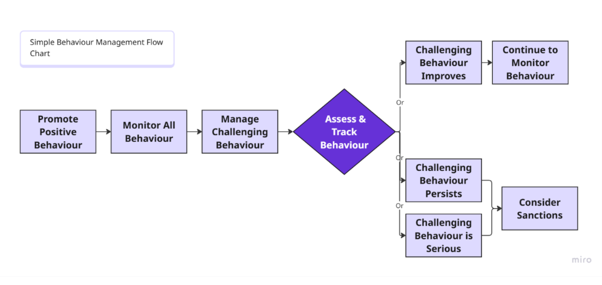
to record incidents of challenging behaviour on an incident form and monitor these for emerging patterns. Records will be maintained in accordance with our data retention policy
to track and regularly review incidents for frequency, escalation, and severity
to introduce a report card for 1 month where there is a continuing pattern of challenging behaviour incidents; a noticeable increase in the frequency of incidents; or incidents become more concerning in nature
Staff will role model positive behaviours remaining calm, responsive and tolerant in challenging situations. They will demonstrate care for others, friendliness and patience when carrying out their role.
Staff will promote an atmosphere where children and adults demonstrate respect and value for one another
Staff will work as a team by discussing children’s behaviour and by taking a collective approach to resolving challenging behaviour
incidents. Staff will work together to maintain awareness of the behaviour of all children attending the club
Staff will help children to find solutions to conflict by using Restorative Practice techniques and the RAID approach (please see
more details below)
Staff will encourage and facilitate mediation between children with the aim of resolving conflict through discussion, empathy, and
negotiation
Staff will always protect and preserve a child’s self-esteem, for example, they will not withhold food, humiliate or use physical
punishment when managing challenging behaviour
Staff will inform Parents/Carers of any concerns regarding a child’s behaviour at the earliest opportunity and explore potential causes with them.
Staff will work in Partnership with Parents/Carers to develop strategies for dealing with the situation together. Incidents will be dealt with confidentially and conversations may take place away from the child if this is appropriate
Staff will inform Managers of challenging behaviour incidents
Managers will ensure staff understand their role and responsibilities for monitoring and managing behaviour in the setting
If staff are unsure of possible strategies to manage challenging behaviour effectively, Managers will assist them in evaluating options
Managers will provide guidance to staff to help them to work in Partnership with Parents/Carers to understand a child’s circumstances and specific needs and to provide regular helpful feedback regarding their child
Managers will Monitor behaviour incidents identifying patterns and assessing the seriousness of incidents escalating or introducing sanctions where appropriate
Parents/Carers will inform and keep Wise Owls Childcare up to date with information about their child’s allergies, dietary requirements, medical or special education needs as per our terms and conditions
Parents/Carers will work in Partnership with Wise Owls Childcare to manage challenging behaviour by providing suggestions and strategies to improve the behaviour
Parents/Carers will help children understand acceptable behaviour and why it is important
Wise Owls recognises that challenging behaviour often falls into one of the following categories:
Disengaged Behaviour
Disengaged behaviour may indicate that a child is bored, unsettled or unhappy. Staff will take steps to understand the reasons for the child’s disengagement and to improve engagement. Some signs may include: Withdrawn, Overly quiet, Becomes lethargic, May start to disrupt others, Seems bored, Lacks enthusiasm, May self-harm or demonstrate other mental health concerns, May be ostracised by others, Unresponsive to efforts to include them
Disruptive behaviour describes a child whose behaviour prevents or restricts other children enjoying themselves. Staff will collectively discuss incidents of disruptive behaviour and agree on the best way to deal with them. Shouting, Knocking things over to prevent play, Try to drag other children away, Pushes others away when they try to play together or join in, Running off, Doesn’t listen to staff or other children, Does not respect boundaries
Unacceptable behaviour refers to non-negotiable actions such as discriminatory remarks, violence and bullying. Staff will be clear that consequences will follow such behaviour, including temporarily removing a child from the activity. When challenging behaviour occurs, staff will ask the child/children involved to explain the reasons for their actions. Staff will explain to the child/children why their behaviour was disruptive, challenging or unacceptable and will discuss the impact and consequences on them and on others. Staff will make every effort to ensure that children understand what is being explained to them. Children will always be given the opportunity to make amends for challenging or disruptive behaviour and, unless it is judged inappropriate to do so, will be able to rejoin the activity. In the event that unacceptable or disruptive behaviour persists, or takes the form of violence, discriminatory remarks, or anything that endangers the health and safety of children or staff, more serious action may need to be taken. At all times children will have explained to them the potential consequences of their actions.
A Note on Physical Intervention When Managing Behaviour
Staff will only use physical intervention as a last resort and only then if they have reasonable grounds for believing that immediate action is necessary to prevent a child from significantly injuring themselves or others, or to prevent serious damage to property.
A dialogue will be maintained with the child/children so that the member of staff can explain any action they are taking and why. Staff will make every effort to avoid the use of physical interventions if they are alone with the child/children.
Only the minimum force necessary to prevent injury or damage will be applied. For example, diverting a child by leading them away by a hand or by an arm around their shoulder. Staff will use physical intervention as an act of care and safety, and never as punishment. As soon as it is safe to do so, the physical intervention will be relaxed and the child allowed to regain their own self-control. The intensity of the physical intervention will always be appropriate to the age, size and strength of the children involved. Violent behaviour that needs to be restrained must be escalated to Head Office.
Where a member of staff has had cause to physically intervene to restrain a child, the Manager must be notified and the incident recorded on an incident form. The incident will be discussed with the Parent/Carer at the earliest possible opportunity.
Consideration will be given to contacting the Director, and, in extreme situations, the police may be called. An incident form will be completed wherever the use of physical intervention has been necessary. Should a member of staff not feel completely confident in their ability to contain a particular situation or type of behaviour, they will be assisted in the first instance by the Manager.
If a staff member is alleged to have committed any act of violence or abuse towards a child at the club, the matter will be investigated, and appropriate disciplinary action will be taken in accordance with our Staff Disciplinary and Safeguarding Procedures. We will also notify any relevant authorities.
A Note on Bullying Behaviour
Wise Owls are committed to providing an environment for children that is safe, welcoming and free from bullying.
Bullying is a very serious offence and is not tolerated, or excused, in any form at Wise Owls, whether the offender be a child or an adult. The victim is never responsible for being the target of bullying.
Wise Owls defines bullying as deliberately hurtful behaviour repeated often over a period of time.
It can come in many forms including but not limited to:
Emotional – Being deliberately unkind, shunning or excluding another person from a group or tormenting them
Physical – Pushing, scratching, spitting, kicking, hitting, biting, taking or damaging belongings, being forced to hand over money, tripping up, punching or using any other form of violence against another person
Verbal – name-calling, put-downs, ridiculing or using words to attack, threaten or insult, teasing
Psychological – behaviour likely to instil a sense of fear or anxiety in another person
Preventing Bullying Behaviour
The Manager and staff will make every effort to create a warm and caring environment where it is made evident and clear that bullying is not acceptable behaviour. Everyone involved including staff, children and Parents/Carers will be made aware of this stance towards bullying. Such behaviour will not be tolerated or excused under any circumstances.
Staff will discuss the matter of bullying openly with children and Parents/Carers including why bullying behaviour will not be tolerated and what the consequences of bullying behaviour would be. Children are made aware that they can and should talk to staff if they feel they are victim of or have witnessed bullying.
Managing Bullying Behaviour
Despite all efforts to prevent it, bullying behaviour can still occur on occasion and the following is in place should bullying be witnessed or reported:
All incidents of bullying will be investigated thoroughly and dealt with in a sensitive manner
If a child or member of staff tells someone they are being bullied, they will be given the time they need to explain what has happened and they will be reassured that they have done the right thing by speaking up
All incidents of bullying witnessed by staff or children must be reported to the Manager. They will take any allegations of bullying seriously and investigate it fully. An incident form will be completed as a record of any allegations made.
Any child who has experienced bullying will be helped and supported by the staff. They will be kept under close supervision and staff will check on their welfare regularly. Staff will inform Parents/Carers of all the children involved in a bullying incident at the earliest possible opportunity and staff will always handle such incidents with due care and sensitivity
After any incidents of bullying, the Manager and other relevant staff will review procedures in respect of bullying
In most cases, bullying behaviour will be addressed according to the strategies and sanctions set out in this policy.
The bully will be encouraged to discuss their behaviour and think through the consequences of their actions. Where appropriate, they will be encouraged to talk through the incident with the other person concerned
Where bullying behaviour persists, more serious sanctions may apply as described in this Policy
Our Approach to Challenging Behaviour that is Persistent or Unacceptable
Although Wise Owls is committed to dealing with challenging behaviour in a positive and constructive manner and working together with children, parents and carers to resolve, there may be occasions when our strategies do not alter, prevent or moderate challenging behaviour. In such cases further action will be necessary, including reviewing a child’s place at Wise Owls, either on a temporary, partial, or a permanent basis.
Details of all incidents of challenging behaviour are recorded on our incident form and each incident discussed verbally with both the child concerned and their Parents/Carers. All staff will be made aware of any incidents concerning a child.
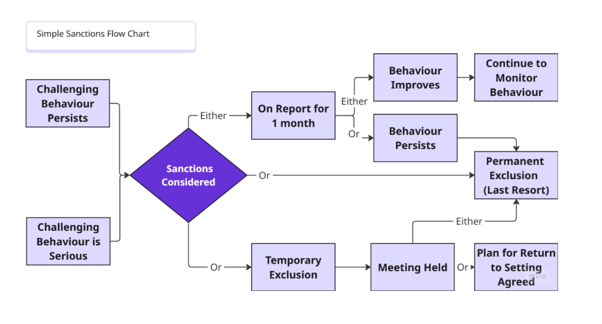
If a pattern of challenging behaviour incidents develops, and there is a persistent, noticeable or sudden increase in incident frequency, or, if incidents become more concerning in nature, we will create a report card for the child in question and behaviour will be closely monitored for one month. Parents/Carers will be informed that their child has been placed on report and will be regularly updated on progress.
If, after one month on report there is little or no behaviour improvement, Head Office will be informed, and they will contact Parents/Carers directly regarding the behaviour.
Staff will consult with the Manager as early as possible if they believe that a child’s behaviour may warrant suspension or exclusion.
The last resort
In line with our terms and conditions, as a last resort, and only in the following circumstances, the setting has the right to temporarily suspend, or permanently exclude a child, with immediate effect:
when it is felt that other children and or staff are potentially at risk of harm
when there is no alternative action that could be taken
in the event of an extremely serious, dangerous or aggressive incident
In such circumstances the child’s Parent/Carer may be contacted without delay and asked to collect their child immediately.
Where a child has been immediately suspended the Manager will arrange a meeting with the child and their Parents/Carers to discuss the incident and to decide if it will be possible for them to return to the setting.
Suspensions and exclusions will be consistent, fair and proportionate to the behaviour concerned. Consideration will be given to the child’s age and maturity and any other relevant information about their situation when deciding on the level of sanction.
Should it be agreed that any suspension is to be lifted, and prior to a child returning to the setting, a discussion will be held between staff, the child, and their Parents/Carers and the conditions of their return will be set out.
Wise Owls Sanctions Summary
1. The escalation of matters by settings to Head Office, or the imposing of sanctions, immediate or otherwise, will be based on the continual monitoring of behaviour in our setting and a thorough assessment of:
Patterns of concerning and challenging behaviour emerging, such as an increased number of incidents occurring over time that do not improve sufficiently even where supportive strategies are introduced, or where there is a sudden spike in the frequency of incidents occurring, or where there is a noticeable escalation in the serious nature of incidents
Any one individual incident deemed exceptionally serious in nature
2. Continued challenging or disruptive behaviour will lead to the introduction of a report card which will be used to closely monitor behaviour for the period of 1 month. Parents/Carers will be informed of this sanction, and staff will continue to manage challenging behaviour with all possible supportive strategies and update Parents/Carers regularly on progress
3. If, after 1 month on report, there continue to be challenging or disruptive behaviour incidents, and strategies to effectively manage those behaviours have been exhausted, as a very last resort, the setting has the right to suspend or partially or permanently exclude a child
4. Serious, violent, or health and safety incidents will be dealt with immediately and Parents/Carers contacted as a matter of urgency, and they will be required to collect their child immediately
5. In the event of serious behaviour that takes the form of violence, discriminatory remarks, or anything that endangers the health and safety of children or staff, the setting has the right to temporarily suspend, or to permanently exclude a child with immediate effect
6. All suspensions whether temporary, partial or permanent, may apply to one or more of or to all Wise Owls settings, and will depend on a thorough assessment of the circumstances.
Behaviour Management Resources and Toolkit
You will find this policy and more resources in your Behaviour Management Toolkit on Sharepoint.